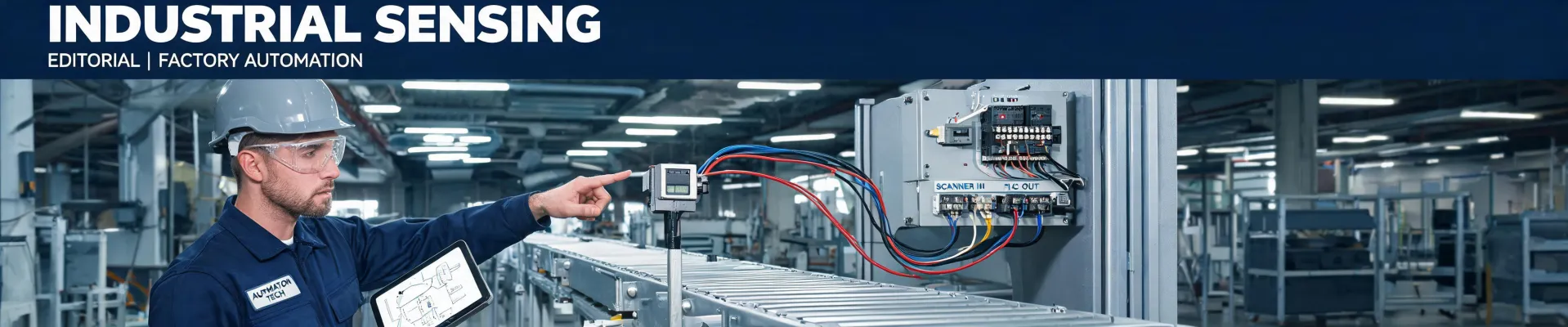
Stop Shopping for Turck Sensors Like They're a Commodity
I've managed procurement for a mid-sized automation integrator for about 6 years now. We spend roughly $180,000 annually on sensors—inductive, flow, radar, you name it. And after reviewing dozens of quotes for Turck sensors, I've landed on a pretty strong opinion: choosing a distributor based on the lowest unit price is actually a mistake. The real value comes from a distributor who understands the product, stocks the right variants, and doesn't waste your engineers' time.
Honestly, I used to think a sensor was a sensor. But watching our team deal with the fallout from 'cheaper' orders changed my mind. This is my argument for why a knowledgeable Turck sensor distributor is worth the premium.
The Hidden Cost of 'Cheaper' Turck Sensors
Let me walk you through a specific experience. In Q2 2024, I compared costs across 4 distributors for a bulk order of Turck inductive sensors and flow sensors. Vendor A quoted $48,000. Vendor B quoted $41,500—a solid 13% saving. I almost went with B until I looked closer.
Vendor B's 'low price' didn't include the right connector variants. We needed M12 quick-disconnects for 60% of the order, but their stock only had the pigtail versions. They could get the M12s, but that added a 3-week lead time and a $25/unit upcharge. Vendor A's quote included the exact part numbers we needed, in stock, with setup fees baked in. When I calculated the total cost of ownership (TCO) factoring in the engineer hours to re-spec the connection and the production delay, Vendor A was actually about 8% cheaper in total. Here's how that broke down:
- Vendor A Quote (Seemingly Higher): $48,000 (all M12 connectors, in stock).
- Vendor B Quote (Seemingly Lower): $41,500 (wrong connectors).
- Engineering Time to Re-spec: 8 hours x $100/hour = -$800 (internal cost).
- Rush Shipping for Correct Parts: +$1,200 (owed to the delay).
- Production Line Idle Time: -$2,500 (this is the killer).
- Vendor B Effective Total: ~$45,800 (savings vanished).
I don't have hard data across the entire industry for how often this happens, but based on my experience tracking about 40 orders a year, my sense is that roughly 20% of 'cheap' quotes miss a critical spec that costs more in the long run.
Why Turck's Product Breadth Demands a Specialist
Turck isn't just a single product line. They have inductive proximity sensors (the standard ones), uprox sensors (factor 1, which is a game-changer for different metal targets), flow sensors for liquids, radar sensors for level, and a massive range of cables & connectors. Then there's Turck encoders and their IO-Link masters. It's basically a universe of parts.
A generalist distributor might have 50 Turck part numbers. A specialist distributor who actively stocks Turck might have 500+ in a local warehouse. When your engineer is on site and realizes a Turck Q12 inductive sensor needs to be swapped for a Q25 because of a mounting bracket issue, you don't want to hear 'that'll be 6 weeks.' The value of a distributor who can say, 'I have that on the shelf, I'll have it to you by tomorrow morning' is worth more than a 5% price break. Seriously, a ton of money is lost waiting for parts.
The 'Expertise' Factor in Technical Support
This is the part I probably undervalue the most. When we first started implementing Turck radar sensors for a tricky tank level application, we ran into issues with false echoes. Our procurement instinct was to just buy from the cheapest source. But the distributor we ended up using (the one who wasn't the cheapest) had a technical sales rep who actually knew the product.
He didn't just sell us the sensor. He asked about the tank material, the agitator speed, and the foam conditions. He then said, 'This isn't our strength, but here's the application note from Turck Support on that specific issue.' He connected us directly with the Turck support engineer who had solved the problem before. That direct line to a real expert? Priceless. If I had bought from a price-only vendor, I would have been stuck reading a manual, probably spec'ing the wrong model, and wasting hours of engineering time. The best part of working with that distributor was the confidence that the solution would work.
I'm not 100% sure how to quantify that 'expertise' in a spreadsheet, but I know it's there.
For example, when comparing quotes for a smaller project using Turck flow sensors, one distributor's tech said, 'This model is great, but for your low-flow range, you should look at the FMM series. It gives better resolution.' The other distributor just asked, 'How many?' The first one saved me from a re-installation.
Counter-Argument: What About Budget Pressure?
I know what you're thinking—'That's easy to say when you have a big budget. We have strict procurement policies that force us to go with the lowest bidder.' I've been there. A few years ago, I was in that exact spot. Our policy was to take the cheapest quote, no exceptions. It resulted in a $1,200 redo when a quality issue popped up with a 'cheap' batch of Turck proximity sensors that didn't quite meet the IP67 rating in a wet environment.
There's something satisfying about hitting a budget target, but when I look back, that policy was shortsighted. The 'cheap' option cost us more in the end. Now, our procurement policy requires a TCO analysis for any order over $2,500. We look at the unit price, but we weigh it against lead time, stock availability, and the distributor's technical support capacity. It's a bit more work up front, but it has cut our emergency expedite costs by roughly 30%.
The Bottom Line on Turck Sensor Distributors
Don't look for the cheapest Turck sensor price. Look for a distributor who can support the product. A good distributor will have the inventory, the product knowledge, and the relationship with Turck to actually help you when something goes wrong. They are the ones who will tell you when a Turck encoder is the right choice and when a Turck uprox is actually overkill. They earn their margin not by being cheap, but by being valuable.
So, when you're sourcing Turck sensors distributors, ask them a hard technical question first. If they fumble, you know the value isn't there. The premium you pay for expertise is almost always an investment that pays back.

Marcus Feld is an electrical test and measurement analyst specializing in multimeters, oscilloscopes, clamp meters, insulation testers, spectrum analyzers, and data loggers. He applies IEC 61010-2-030 and IEC 61010-031 concepts while examining measurement category, bandwidth, true-RMS response, input loading, and stated uncertainty. His work helps maintenance engineers and test teams choose safe instruments with performance suited to the signals and environments they actually measure.
Leave a Reply