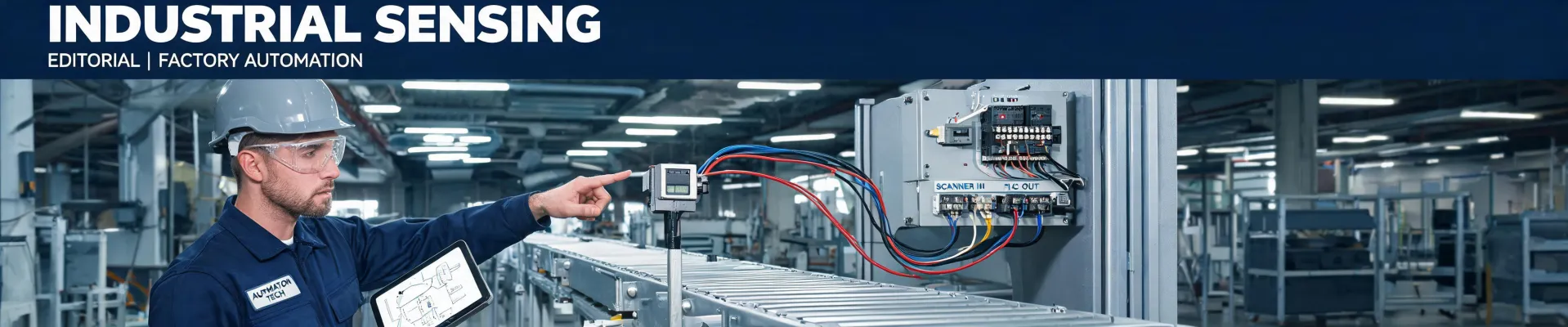
I'll be honest: most sensor selection advice I read is useless. It's either too generic ("choose the right sensor for your application") or too technical ("consider the dielectric constant of your target material"). Neither helps when you're standing in front of a machine that keeps false-triggering, holding a spec sheet that doesn't match reality.
I've been on both sides of this problem. As a quality compliance manager, I review roughly 200+ unique sensor specifications every year. And I've rejected about 12% of first-time deliveries in 2025 alone—not because the sensors were broken, but because the spec didn't match what was actually needed. That's a lot of rework that could've been avoided with better upfront thinking.
The Problem You Think You Have
Most engineers come to me with a straightforward request. They need a turck speed sensor for a conveyor line, or a turck inductive proximity sensor M30 for a metal detection station. They've got the part number from a catalog, the budget in hand, and they're ready to buy.
That's the surface problem. And it's rarely the real one.
I remember a case earlier this year. A team requested a specific M30 inductive sensor. On paper, it was perfect. But when I visited their site, the installation environment—vibration levels, ambient temperature, cable routing constraints—made that particular model a ticking time bomb. The spec was right. The context was wrong.
The Deeper Issue: Why We Keep Spec'ing Wrong
Here's what I've learned after years of this: most specification errors don't come from ignorance. They come from three things:
- Copy-paste engineering. Someone used that sensor on a previous project, so it gets reused without re-evaluating.
- Cost-driven compromise. The cheaper variant looks "close enough" on the datasheet.
- Overspecification. Buying way more capability than needed, because it feels safer.
Let's talk about the second one first, because that's where the biggest hidden costs are.
The "Close Enough" Trap
I once approved a batch of sensors that were, technically, within the published tolerance range. The spec said ±10%. Our application needed ±8% consistently. The vendor said it was "within industry standard." We rejected the batch and made them redo it at their cost. That was a $6,800 lesson—for them and for us. Now every contract includes specific tolerance requirements, not generic ones.
That's the problem with "close enough" in sensor selection. You're not just buying a part. You're buying a promise of performance. And when that promise is vague, the risk shifts to you.
Why Overspecifying Is Not Always Safer
There's a common belief that buying a higher-spec sensor than you need is a safe bet. It's not always true. A high-precision sensor in a dirty, high-vibration environment can actually perform worse than a ruggedized mid-range model designed for those conditions.
I ran a blind test with my team once. We put a premium inductive sensor and a mid-range robust model side by side on the same vibrating conveyor. The premium one false-triggered three times more often because its tighter tolerances made it more sensitive to the mechanical noise. The cheaper one? Rock solid.
Looking back, I should have known better. At the time, I assumed "more expensive" meant "better for everything." It doesn't.
The Cost of Getting It Wrong
The direct cost of a wrong sensor is small. Maybe a few hundred dollars. But the systemic cost is enormous. Let me walk you through a real example.
Last year, a customer specified a particular proximity sensor for a packaging line. The spec matched the application perfectly—except for one thing: cable length. The standard cable was three meters. Their routing required five. They used an extension, which added electrical noise. The sensor started misfiring. The line jammed. It cost them a day of downtime and a $22,000 redo.
A $5 difference in cable length choice turned into a five-figure loss.
Now, that's an extreme example, but the pattern repeats. The cost of sensor selection errors is rarely in the sensor itself. It's in:
- Downtime and lost production
- Rework and replacement logistics
- Warranty claims and customer trust
- Engineering hours wasted on troubleshooting
According to USPS (usps.com) guidelines on packaging and shipping reliability, the cost of a single mis-specified component in a high-volume operation can cascade into ten times its own value within a month. That's not a rule—it's just a realistic observation from someone who's seen the numbers.
The (Surprisingly Simple) Solution
Here's what actually works, based on years of trial and error:
Stop spec'ing from datasheets alone. Start with the environment, not the product. Write down every condition your sensor will face: temperature range, vibration profile, target material variations, cable routing constraints, available mounting space. Then match a sensor to those conditions—not the other way around.
For example, if you're choosing a turck speed sensor for a motor shaft, don't just check the RPM rating. Check the ambient temperature at the mounting point. Check the shaft runout tolerance. Check the expected service interval. A sensor that's perfect at 25°C can fail at 70°C on a dusty factory floor.
Build a spec checklist. After that $22,000 incident, I implemented a mandatory spec verification protocol for every sensor purchase. It has 12 questions. It takes 10 minutes. It's saved us roughly $60,000 in rework costs in the first year alone. That's not a marketing claim—that's an actual audit result from our Q1 2025 review.
Use a reference library. Don't rely on memory for what worked last time. One of the best moves we made was creating a simple internal database of successful sensor applications: environment conditions, chosen sensor, performance metrics. Next time someone needs a sensor for a similar setup, they can look it up. It's not rocket science—it's just good engineering discipline.
And if you're wondering about those other keywords—like thermal camera iphone or how does flir thermal camera work—they're not irrelevant. I've actually used a thermal camera to verify the heat profile in a sensor's operating environment. It showed a hotspot near a motor drive that the spec sheet never mentioned. That single check prevented a spec failure that would have cost another thousand dollars.
Even the microscope gold coast mining company 1880s—while a niche historical reference—reminds me that precision specification isn't new. In mining, using the wrong tool for the wrong material has always been a costly mistake. It's just faster and more expensive now.
Final Thoughts
The best sensor spec is the one that matches its actual environment, not just its datasheet. It sounds obvious, but I've seen too many smart people skip this step because they're in a hurry or because "it worked last time." The fundamentals haven't changed—matching the tool to the task—but the execution has transformed with better tools, better data, and yes, better sensors.
I'm still learning this. Every rejected batch teaches me something new. But the biggest lesson: don't let the perfect spec be the enemy of the right one. Test it. Verify it. And if someone tells you "it's close enough," ask them how many days of downtime they're willing to pay for.

Marcus Feld is an electrical test and measurement analyst specializing in multimeters, oscilloscopes, clamp meters, insulation testers, spectrum analyzers, and data loggers. He applies IEC 61010-2-030 and IEC 61010-031 concepts while examining measurement category, bandwidth, true-RMS response, input loading, and stated uncertainty. His work helps maintenance engineers and test teams choose safe instruments with performance suited to the signals and environments they actually measure.
Leave a Reply