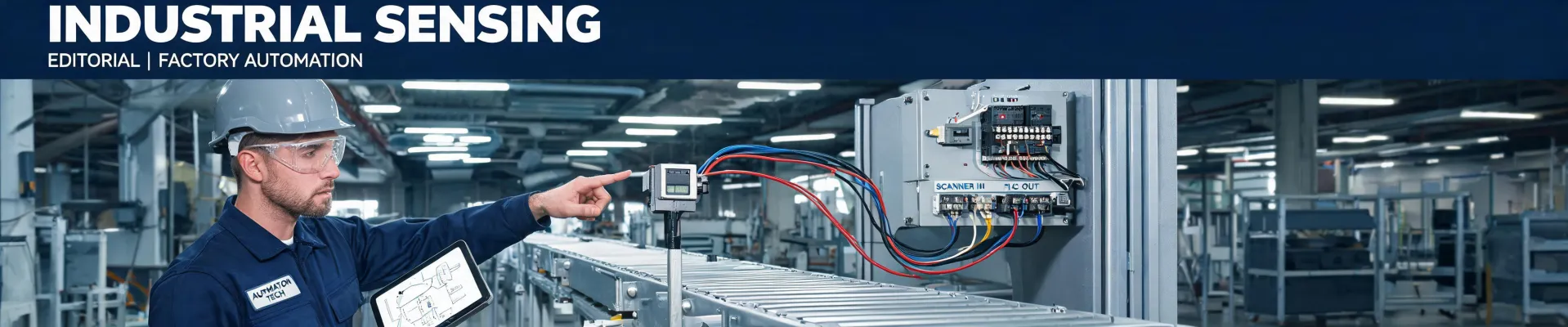
I've been managing purchasing for a mid-size manufacturing company since 2020. That's roughly 60-80 orders a year, spread across 8 active vendors, covering everything from Turck proximity sensors to the pipette pens our lab reorders every quarter. And after five years of chasing quotes, haggling over line items, and getting burned more than once, I've landed on one opinion I'll defend against anyone:
The vendor with the lowest upfront quote is rarely the cheapest. I now ask "what's NOT included?" before I ask "what's the price?"
That single question has saved us more than any discount ever did. Let me explain why—and what it has to do with a turck sensor tester.
A $400 Lesson in "Included"
In early 2022, our maintenance team asked me to source a turck sensor tester. If you've never used one, it's a handheld device that lets a technician quickly verify whether a sensor is switching correctly before they reinstall it. Our maintenance lead described the old method as "a multimeter, a loose wire, and a lot of swearing." An upgrade was long overdue.
I requested quotes from three vendors. One came in about 15% lower than the other two. Fifteen percent—that's the kind of number that catches a purchasing person's attention, especially when finance is watching every line item. I was ready to approve it.
Then I asked the question I'd learned to ask the hard way: "What's NOT included?"
Turns out, a lot. The test leads were an additional $119. The carrying case was another $45. And setup support? "We can provide a quote for that."
By the time I added back the pieces that should have been in the kit, the "bargain" was more expensive than the Turck quote—which included everything from the start. The tester, the leads, the case, and access to a support team that actually picked up the phone.
I don't have hard data on how often this pattern shows up across the industry. But based on five years of orders, my sense is that roughly a third of the "lowest" quotes end up costing more once you add back the essentials. It's not that vendors are trying to trick you. It's that a low headline number is a classic way to win the bid before the real conversation starts.
What "Turck Support" Actually Meant
What really sold me on the Turck option wasn't the paperwork. It was what happened after the order.
Our tech needed to test a sensor that wasn't pairing with the tester. He called me, I contacted turck support, and within ten minutes they'd identified it as a firmware issue and walked him through the update. Ten minutes. One call. Problem solved.
Now imagine the alternative. The "bargain" vendor had no phone support—email only. That fix would have taken a day, a back-and-forth ticket, and a technician sitting idle while production waited. I do not need to explain to you how that conversation with the VP goes.
That's a cost that never shows up on a purchase order. But it's real. And when you're the person responsible for keeping operations running, it's often the only cost that matters.
The Hidden Cost Nobody Quotes For: Time
Here's the thing people don't expect: hidden costs aren't just about money. They're about time.
I spend a surprising portion of my week answering internal questions about equipment we've already bought. The lab supervisor asks why the refill cartridges for their pipette pens no longer fit the handles—turns out the vendor changed the design without updating the product page. A new operator brings me a digital caliper and asks how to turn on mitutoyo micrometer. These are simple questions that should take two minutes to answer. But only when the vendor provides decent documentation.
The micrometer thing is a real example. The digital display only wakes up when you press the ON/OFF button—which, on some models, is also the zero-set button. Not intuitive. The manual explains it, but only if you kept the manual. A vendor with good documentation eliminates these time sinks. Bad documentation turns a two-minute answer into a 30-minute research project involving forums, outdated PDFs, and a lot of squinting at diagrams.
Last year, I bought a digital pressure gauge for our quality lab based on price alone. The gauge itself was fine. But the calibration certificate—which our procedures require for any instrument used in process verification—was an extra $150. Plus a week of waiting because the certificate was handled as a separate line item. Our quality manager was not happy. And she made sure I knew it.
So glad I checked the details on that order before committing to the same vendor for our annual sensor replacement cycle. But that near miss taught me something about how much friction a non-transparent quote can create down the line.
The Objection: "Just Negotiate Harder"
"If you were a better negotiator, you wouldn't need transparent vendors."
I hear this sometimes from colleagues. And honestly? There's a kernel of truth in it. I've definitely gotten better at reading quotes since 2020—I catch the missing calibration fees faster, I spot the vague "additional parts required" language earlier.
But a process where I have to interrogate every line item is a broken process. The vendor who lists all fees upfront—even when the total looks higher—has effectively done the negotiating already. They're showing you the real number. I don't have to decode their quote. I don't have to schedule a follow-up call to ask what they meant by "accessories sold separately." I just know.
That's not about being street smart. It's about being treated like a person who deserves straight answers.
What I Check Now
Since that Turck order, I've been running a short checklist before approving anything above $1,000. It saves me from quote anxiety and saves finance from invoice surprises:
- What is NOT included? If the answer is vague, I cross the vendor off the list.
- Calibration: Is the certificate included, and is it NIST-traceable? (Our quality lab requires it per our ISO 9001:2015 procedures.)
- Support: Does the price cover access to real people during setup? Or is it billed by the hour?
- Consumables: If it's a tool, are cables, tips, and other pieces in the box, or added later?
Some vendors answer these questions in their first quote without prompting. Those are the ones I reorder from. The ones who say "let's discuss your specific needs" never seem to end up cheaper—they just take more of my calendar.
I'll be straight with you: Turck answered those questions better than most. That's partly why they show up on so many of our purchase orders. But this isn't an ad for one brand. It's the opposite—it's a request for every vendor to show their full hand on the first pass.
I don't need a vendor to be the cheapest. I need a vendor to be honest about the full price. Everything else follows from that.
That's the lesson five years of purchasing taught me. And the turck sensor tester sitting in our maintenance room—the one that came with everything, including people who answer the phone—is the proof I keep pointing to.

Marcus Feld is an electrical test and measurement analyst specializing in multimeters, oscilloscopes, clamp meters, insulation testers, spectrum analyzers, and data loggers. He applies IEC 61010-2-030 and IEC 61010-031 concepts while examining measurement category, bandwidth, true-RMS response, input loading, and stated uncertainty. His work helps maintenance engineers and test teams choose safe instruments with performance suited to the signals and environments they actually measure.
Leave a Reply