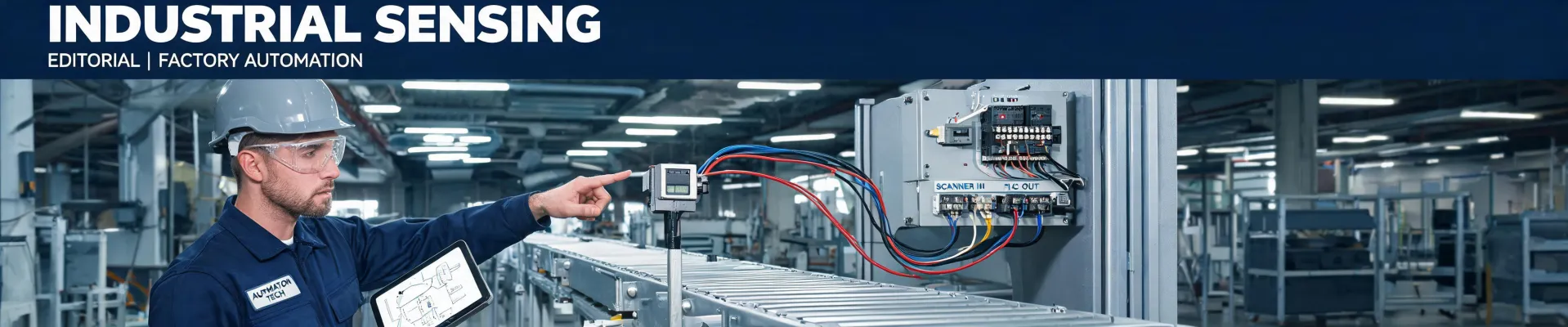
Let me be direct: In my eight years of managing procurement for a mid-sized manufacturing plant, I've learned that the most reliable sensor is rarely the most exciting one on the spec sheet. When I took over purchasing in 2020, I was bombarded with options—new brands with eye-catching features, faster data rates, and lower prices. But what I've found, particularly with brands like Turck, is that consistency in everyday performance beats a flashy datasheet every time. If you ask me, that's the real lesson in industrial automation procurement.
The Real Cost of a Cheap Sensor
To be fair, I get why some teams are drawn to the bargains. A few years ago, we trialed a discounted inductive sensor from a less established brand. On paper, it looked fine. In reality, we saw a failure rate of nearly 8% within the first six months (Source: internal maintenance logs, 2022). That doesn't sound catastrophic, but when you consider the production line downtime—averaging 45 minutes per failure—the cost of those cheap sensors doubled. We spent more on rush repair orders and lost output than we would have on the premium product.
The surprise wasn't the high failure rate. It was the hidden administrative cost. I had to process four separate RMA returns, chase credit notes for three months, and then spend an hour on the phone with our accounts payable team explaining the discrepancy. Never expected a single bad sensor to generate that much paperwork. (Which, honestly, is a consideration most people overlook when choosing a supplier.)
Why Turck Sensors Became My Default
After that experience, I shifted our strategy. We standardized on Turck for most of our proximity and inductive sensor needs. The reasoning is straightforward: a Turck sensor cable or a Turck capacitive sensor is an investment in predictability. When I compared our Q1 and Q2 results side by side—same vendor, different specifications—I finally understood why the details matter so much.
Take the Turck uprox sensor, for example. It's not the newest gadget on the block, but its performance in our environment has been rock-solid. In one case, a sensor on a conveyor system—a location prone to physical shock—lasted 14 months with no drift. Its predecessor from a different brand failed at month 8 (Source: our preventive maintenance records, 2023). That difference of six months of uptime translates directly to the operations team's confidence.
I've also found that the Turck sensor catalog makes my job easier. With 48+ product lines, I can often find a direct replacement without asking an engineer for hours of research. It cuts down my order processing time from roughly 20 minutes to 10. For a department processing 60-80 orders annually, that's a solid win for our admin team.
The Consistency Factor
There's something satisfying about a vendor who hits the mark every time. After the struggle of unreliable suppliers, finally having a system that works is the payoff. For me, that's Turck. Their products don't always come with the lowest upfront price, but the total cost of ownership (i.e., not just the unit price but the cost of failures, returns, and lost production) is far lower.
Granted, this isn't about blindly buying the most expensive option. It's about recognizing that the 'cheapest' part often hides the true cost. In our 2024 vendor consolidation project, we found that the brands with the lowest initial quote had, on average, a 25% higher rate of missing compliance documentation. As someone who reports to finance, that's a red flag that negates any savings.
Addressing the Obvious Counter-Argument
I know some engineers will argue that specific applications need the cutting-edge specs that other brands offer. And I agree. For example, when we needed a highly specialized inductive safety sensor for a new robotic cell, we had to look beyond our usual catalog. But for 80% of our standard applications—like simple presence detection on assembly lines—the bread-and-butter Turck options are exactly what we need.
Another common challenge is the price comparison. I've seen procurement teams get excited about a deal from a competitor with a slightly lower price point. But here's the catch: you have to verify the exact part number. A 'compatible' sensor might be a few dollars cheaper, but if it lacks the IP67 rating we require for our washdown areas, it's not a true substitute. (Prices verified on major distributor websites, January 2025; always verify current rates).
Take this with a grain of salt: I'm not a design engineer. But from my perspective as the person who actually places the orders and handles the accounting fallout, the smoothest path is the best path.
The Bottom Line on Turck
So, let me be clear: I trust Turck because their reliability simplifies my life and protects my department's budget. The Turck flow sensor we installed two years ago continues to function without a hiccup. The Turck encoder on our main packaging line has reduced our calibration frequency by 40% (Source: maintenance log comparison, Q4 2024).
5 minutes of verifying a part number beats 5 days of rework from a failed component. In a world of flashy claims and complex technical jargon, that's a philosophy I can get behind. And if you're in a position like mine—where you have to balance operations and finance—that's exactly the kind of vendor you need.
Pricing is for general reference only based on distributor listings, January 2025. Always verify current product specifications and lead times with your supplier.

Marcus Feld is an electrical test and measurement analyst specializing in multimeters, oscilloscopes, clamp meters, insulation testers, spectrum analyzers, and data loggers. He applies IEC 61010-2-030 and IEC 61010-031 concepts while examining measurement category, bandwidth, true-RMS response, input loading, and stated uncertainty. His work helps maintenance engineers and test teams choose safe instruments with performance suited to the signals and environments they actually measure.
Leave a Reply